How to Choose the Right Ethernet Switch SFP Port for Your Network Needs?
Choosing the right Ethernet Switch SFP port is crucial for optimizing your network. John Doe, a leading expert in network infrastructure, states, "The right SFP port can significantly enhance data transfer efficiency." Each network has unique demands, and these choices can lead to better performance.
Consider factors like bandwidth requirements and distances. Understanding your specific needs matters. For instance, a small office may need fewer ports than a large data center. The variety of SFP options can feel overwhelming. It is easy to make a hasty choice that doesn’t fit your network.
Reflect on your current and future needs. Will your network expand? Will you require higher speeds or more connections? Choices made today can influence your efficiency tomorrow. Evaluating these elements will guide you to the right Ethernet Switch SFP port for your goals.
Understanding Ethernet Switch SFP Ports and Their Functionality
When selecting an Ethernet switch SFP port, understanding its functionality is crucial.
SFP ports serve as adaptable interfaces, supporting various connection types, including fiber optic and copper.
With the global market for Ethernet switches projected to reach $25.4 billion by 2026, the demand for optimized network solutions is rising.
Many organizations now face challenges in choosing the right SFP modules. They often overlook compatibility issues, leading to performance degradation.
The importance of data transmission speed cannot be overstated.
According to recent reports, 10 Gbps SFP+ ports are becoming standard in high-performance networks.
These ports enable faster data transfer and reduce latency significantly. However, not all applications require this level of speed.
If an organization primarily relies on basic tasks, a lower-speed option may suffice. Thus, flexibility in choosing the right SFP port is vital.
A common pitfall when choosing SFP ports is underestimating future scalability. Many businesses choose a basic SFP option,
only to find themselves needing upgrades shortly after. Planning for future growth is essential. Your network should be able to evolve without
replacing core components frequently. For sustainable development, keep in mind your current and future network requirements.
This ensures a balanced approach to network expansion.
Evaluating Your Network Requirements for SFP Port Selection
When selecting an SFP port for your network, it’s essential to evaluate your specific requirements. Consider factors such as bandwidth, data transfer rates, and future scalability. An SFP port can support various speeds, typically ranging from 1 Gbps to 100 Gbps. According to industry reports, networks that anticipate heavy data traffic should plan for higher speeds. For example, 10 Gbps SFP ports are becoming standard in high-demand data centers.
Moreover, take note of the type of connection needed. Fiber cables can support longer distances compared to copper connections, which are ideal for shorter runs. This can significantly impact performance in large facilities. The total cost of ownership must also factor in. As highlighted by a recent study, the total cost for deploying a 10 Gbps network versus a 1 Gbps network shows that the latter can multiply operational expenses over time due to increased congestion and slower transfer rates.
Lastly, think about your current and future applications. Network demands change rapidly. A plan that works now may not meet future needs. While selecting the right SFP port involves rigorous analysis, ensure flexibility for evolving technologies. Achieving a balance between immediate needs and future growth can be challenging, but it’s crucial for sustainable network performance.
How to Choose the Right Ethernet Switch SFP Port for Your Network Needs?
| SFP Port Type |
Maximum Speed |
Typical Use Case |
Distance |
Connector Type |
| SFP |
1 Gbps |
Data Center Interconnections |
Up to 100 meters (using Cat 5e) |
LC Connector |
| SFP+ |
10 Gbps |
High-speed Backbone Connections |
Up to 300 meters (OM3) |
LC Connector |
| SFP28 |
25 Gbps |
Data Center and Cloud Deployments |
Up to 400 meters (OM4) |
LC Connector |
| QSFP+ |
40 Gbps |
High-Performance Computing |
Up to 150 meters (OM3) |
MTP/MPO Connector |
| QSFP28 |
100 Gbps |
Data Center Core Switching |
Up to 100 meters (OM4) |
MTP/MPO Connector |
Comparing Different Types of SFP Modules and Their Applications
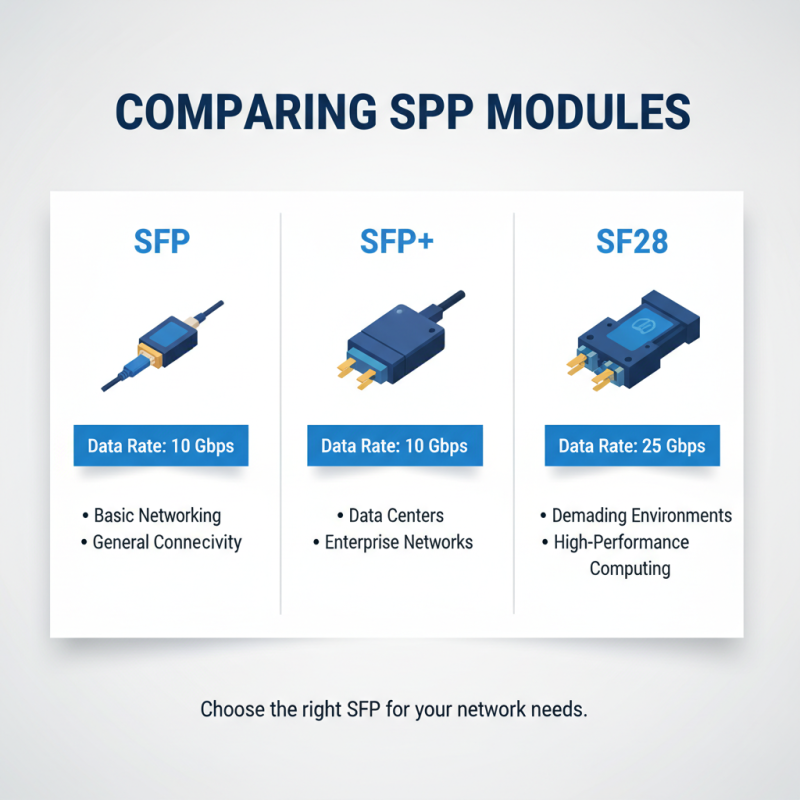
When selecting SFP modules, it’s crucial to understand their types and applications. The most common types include SFP, SFP+, and SFP28. SFP modules typically support data rates up to 1 Gbps. They are great for basic networking tasks. If you require higher speeds, SFP+ provides support for 10 Gbps and is ideal for data center applications. SFP28 takes it further, enabling 25 Gbps connections for demanding environments.
Tips: Always verify compatibility with your hardware. Mismatched components can lead to poor performance or connection issues.
Additionally, consider the distances your network covers. Short-range SFP modules are perfect for connection within buildings, while long-range options support distances up to tens of kilometers. Knowing the exact requirements can prevent potential pitfalls.
Tips: Don’t overlook the importance of fiber type. Single-mode and multi-mode fibers serve different purposes, affecting performance significantly.
Choosing the right SFP port can seem challenging. The variety of options may feel overwhelming. Reflecting on your specific network needs will lead to a more efficient selection. It’s essential to balance cost and performance for long-term efficiency.
Factors to Consider When Purchasing Ethernet Switches with SFP Ports
Choosing the right Ethernet switch with SFP (Small Form-factor Pluggable) ports can be pivotal for network efficiency. When assessing your options, key factors must be considered. Firstly, compatibility with current devices is crucial. Not all SFP ports support the same transceiver types. Ensure your chosen switch can integrate seamlessly with your existing infrastructure.
Port density is another essential consideration. According to the latest research from industry analysts, companies face challenges as the demand for bandwidth increases. A switch with a higher port density allows for more connections without additional hardware. This is important for growing networks that need scalability.
**Tip:** Always evaluate your future needs. What seems sufficient now may not be in a few years.
Speed is also vital. Different Ethernet switches offer varying speeds, including 1G, 10G, or even higher. Ensure you analyze the requirements of your applications. The mismatch between speed and needs can lead to bottlenecks.
**Tip:** Conduct a network audit before purchasing. It can reveal hidden constraints.
Lastly, consider the quality of support and warranty. A dependable vendor can save you time and stress. Poor support may leave you in a vulnerable position when issues arise. Thus, think carefully about whom you trust.
Future-Proofing Your Network: Scalability and Compatibility of SFP Options
When considering the scalability and compatibility of SFP options for your network, it's essential to focus on future-proofing. Ethernet switches with SFP ports allow for flexibility. They support various speeds and cable types. This means your network can grow without a complete overhaul.
One vital tip is to assess your current needs and project future demands. Imagine adding more devices or increasing data traffic. Will your existing infrastructure handle it? Choosing SFP modules that support higher speeds, like 10GbE or beyond, can save time and costs later. Compatibility with a range of fiber types, such as single-mode and multi-mode, enhances your options.
Remember, not all SFPs are created equal. You might encounter issues with compatibility across different brands. It's a common pitfall. Research your switch specifications carefully before investing in SFP modules. Ensure they align with your chosen switch to avoid frustrations in the long run. A well-thought-out approach will keep your network efficient and agile.
Network Scalability and Compatibility of SFP Options